⚠️This post is for general educational purposes only. It does not supersede local facility rules, fire codes, or firearm manufacturer specifications. Range policies, trap limitations, and backstop infrastructure vary widely by location. Always confirm approved ammunition types directly with your local facility and consult your owner’s manual before heading to the firing line.⚠️
In Part 1, we established why indoor ranges turn away your bulk-pack steel-cased ammo to protect their ventilation, backstops, and brass buckets. But even if you are shooting outdoors where the range officers don’t care, your firearm absolutely does.
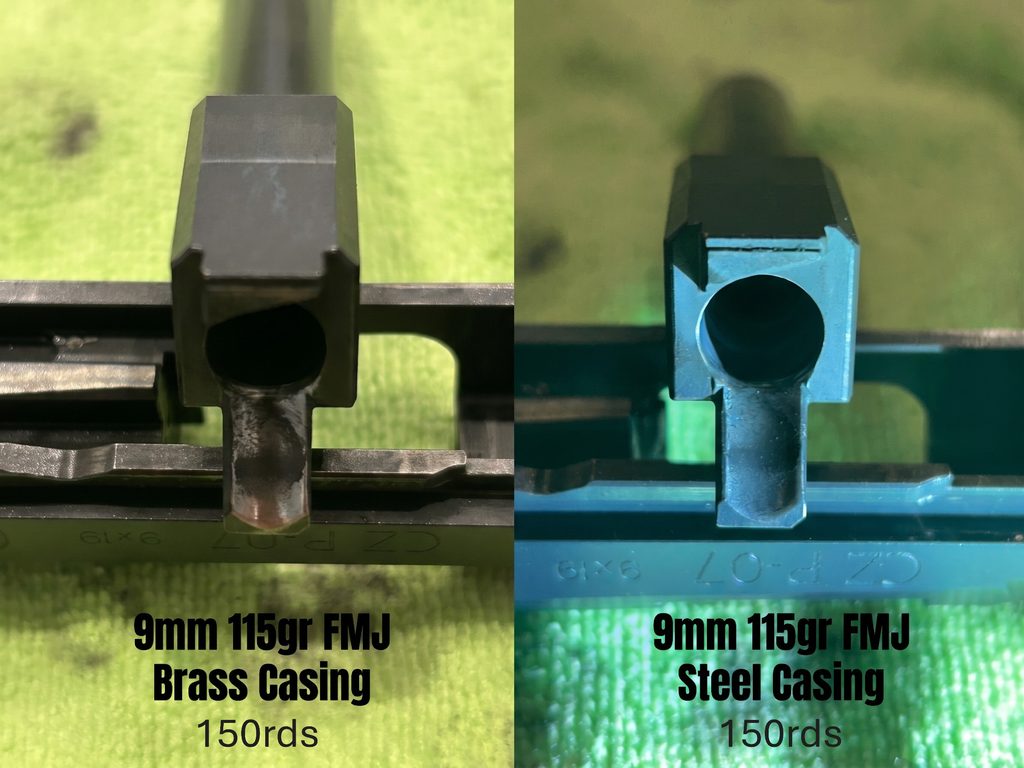
To demonstrate exactly what budget steel casings do to a handgun’s internals, we ran a direct, apples-to-apples 150-round test through a CZ P-07 using 9mm 115-grain FMJ.
The Chamber Seal Failure:
Brass is a naturally malleable alloy. When a brass cartridge detonates, the casing physically expands outward, creating a tight, temporary seal against the chamber walls. This seal forces the dirty, high-pressure combustion gases exactly where they belong: out the front of the barrel.
Steel casings do not possess that same elasticity. When the round fires, the rigid steel fails to expand completely. That microscopic gap allows abrasive carbon fouling and unburnt powder to blow straight backward into the action of your pistol. As you can see in the photo of the steel-fired feed ramp, just 150 rounds left the CZ P-07 caked in a thick, gritty sludge.
The Extractor Strain:
Modern firearms are built to handle abuse, but repeatedly forcing a hardened steel extractor claw to grip and yank a rigid steel rim creates unnecessary metal-on-metal wear. Over thousands of rounds, this accelerates fatigue on the extractor spring and the claw itself, increasing the likelihood of failure-to-extract malfunctions.
By contrast, the 150 rounds of standard Federal brass left the exact same feed ramp clean and functional, with only normal friction wear visible. The brass sealed the chamber perfectly, keeping the fouling downrange.
The Cleanup Reality:
Anyone who has spent a day in the military knows the distinct smell and utility of CLP. It is the universal fix-all for breaking down carbon and keeping hardware running in the field. For civilian training, “Break Free CLP” remains a baseline essential. I recommend putting it on an Amazon Subscribe & Save so you never run dry at the bench. But when it comes to dedicated lubrication after the carbon is cleared out, that classic bottle of Hoppe’s gun oil is a permanent fixture.
When you shoot standard brass, a quick spray of Break Free to clean the action, followed by a wipe-down and a few drops of Hoppe’s on the slide rails, is usually all it takes to keep your pistol running smoothly. But when you run steel casings, you are signing up to let that CLP dwell while you aggressively scrub heavy, caked-on carbon out of your feed ramp with a nylon brush.
Investing in brass isn’t just about passing the magnet test at the counter—it is about preserving your extractor and saving yourself from unnecessary scrubbing.
Train smart, shoot clean.
⚠️This post is for general educational purposes only. It does not supersede local facility rules, fire codes, or firearm manufacturer specifications. Range policies, trap limitations, and backstop infrastructure vary widely by location. Always confirm approved ammunition types directly with your local facility and consult your owner’s manual before heading to the firing line.⚠️