
⚠️This post is for general educational purposes only. It does not supersede local facility rules, fire codes, or firearm manufacturer specifications. Range policies, trap limitations, and backstop infrastructure vary widely by location. Always confirm approved ammunition types directly with your local facility and consult your owner’s manual before heading to the firing line.⚠️
You bought a case of cheap steel-cased 9mm. The RSO puts a magnet on the bullet, not the box, and walks you back to the parking lot. That isn’t a personality test. Indoor ranges are protecting steel, housekeeping, and a brass bucket. They are also sloppy with language. So are most articles about this.
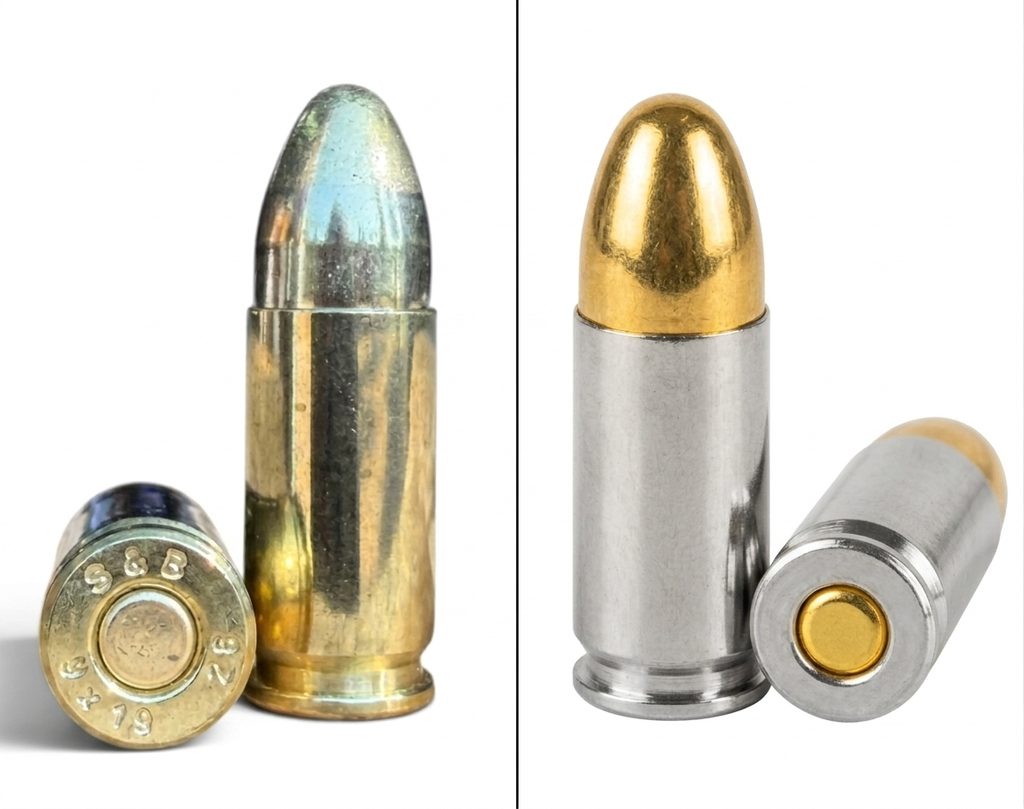
Separate the parts before you argue with anyone.
- Steel case (the hull): Magnetic. Not reloadable. Contaminates scrap brass. Does not spark when it hits the trap. It already left the gun.
- Bimetal jacket: Mild steel under a thin copper wash over a lead core. Looks like copper FMJ. Fails a magnet. This is what most Wolf, Tula, Barnaul, and Brown Bear pistol ammo actually is.
- Steel Core: A hard penetrator inside the bullet (M855 green tip, true AP, some surplus). This is what actually wrecks plates.
Cheap imports usually stack the first two. Ranges collapse all three into “no steel.” Fast screening beats a metallurgy seminar at the counter.
The fire problem is the projectile, not the hull.
Indoor ranges accumulate unburnt powder, paper fiber, and dust downrange. That residue is a fuel bed if the place is dirty. Navy and NIOSH guidance on indoor ranges treats unburned propellant as a fire and explosion concern when cleaning slips (Navy and Marine Corps Public Health Center 2022; NIOSH).
Sparks come from “ferrous material in the bullet” hitting steel baffles, deflection plates, or concrete. A bimetal jacket is steel. A steel core is steel. The empty steel case is sitting at your feet.
The best-measured version of this mechanism is not an indoor-range myth. Forest Service researchers fired common rifle cartridges (5.56×45, 7.62×39, 7.62×51, 7.62×54R) into AR500 steel and dropped the fragments into oven-dried peat (about 3–4.5% moisture). Bullets with steel in the core or jacket, and solid copper bullets, ignited that fuel reliably. Lead-core, copper-jacketed bullets produced one ignition in the test series. Infrared video and temperature-sensitive paints indicated fragment temperatures could exceed 800°C. That is rifle energy into bone-dry fuel against a steel plate; not a 9mm into a swept indoor lane. So “one spark, bunker inferno” is marketing. The ignition mechanism is not (Finney et al. 2013).
The paper’s own hedge matters: fragments cool fast, and ignition needs fine, very dry fuel close to the impact. Housekeeping is the other half. A clean range with a rubber or well-maintained trap is a different animal from a bunker that hasn’t been vacuumed. Policy is written for the worst Tuesday, not your best one.
Traps are built for lead that mushrooms.
Commercial bullet traps and steel backstops are designed around soft lead cores in copper jackets. Lead deforms. Energy dumps into a predictable splash.
Steel-core does not play that game. It stays hard, pits plate, and throws fragments on angles the designer didn’t budget. That is the real infrastructure killer. Ricochet risk goes up when the plate is cratered.
Bimetal jackets sit in the middle. Mild steel is harder than copper gilding metal. It accelerates wear on plates and baffles compared with copper FMJ. It is not M855. Treating a 115-grain bimetal 9mm like armor-piercing rifle ammo is lazy. Treating it like copper is also lazy. Missouri’s staffed ranges ban both steel-core and bi-metal jackets because the trap manufacturer told them to (Missouri Department of Conservation 2021). That is the adult version of the rule.
The magnet is a screen, not a lab
The RSO cannot see through a copper wash. Bimetal looks like FMJ. So they magnet the nose of the bullet. If it sticks, you don’t shoot it. That is the correct test.
Magnet on the case also sticks. That is why bad ranges write “no steel case” and confiscate your Saturday. A steel-case load with a copper-jacketed lead bullet exists (some Magtech steel-case 9mm lots). It would pass a bullet-only magnet and still annoy the brass bucket. Call first. Do not litigate this in the lobby.
The brass bucket is not a safety briefing.
Indoor ranges sweep brass and sell it. Clean cartridge brass is money. Steel and aluminum in the drum get the whole lot downgraded or rejected. Sorting with a magnet is labor. That is a P&L rule wearing a safety vest.
It is a legitimate reason to ban steel cases. It is not why the trap sparks. Don’t let staff blend the two into one sermon. Don’t pretend the recycling argument is fake, either.
What to actually do?
- Indoor steel trap or unknown housekeeping: copper-jacketed, lead-core, brass-case. Magnet the nose at home.
- Steel-case with a copper jacket: only if the range’s written policy bans cores/jackets and not hulls. Confirm.
- Steel-core, green tip, AP, tracer, incendiary: leave it at home. This is not a debate. You will not win the argument.
- Outdoor, dirt berm, no steel plates: steel-case is usually a non-event. Fire restrictions in dry country still care about steel jackets and cores.
Buy the right bulk ammo or shoot somewhere that doesn’t have a steel wall and a P&L statement as a self-licking ice cream cone.
⚠️This post is for general educational purposes only. It does not supersede local facility rules, fire codes, or firearm manufacturer specifications. Range policies, trap limitations, and backstop infrastructure vary widely by location. Always confirm approved ammunition types directly with your local facility and consult your owner’s manual before heading to the firing line.⚠️
SOURCES:
Finney, Mark A., Trevor B. Maynard, Sara S. McAllister, and Ian J. Grob. 2013. *A Study of Ignition by Rifle Bullets.* Research Paper RMRS-RP-104. Fort Collins, CO: U.S. Department of Agriculture, Forest Service, Rocky Mountain Research Station. https://www.fs.usda.gov/rm/pubs/rmrs_rp104.pdf
Finney, Mark A., Trevor B. Maynard, Sara S. McAllister, and Ian J. Grob. 2015. “A Study of Wildfire Ignition by Rifle Bullets.” *Fire Technology*. https://link.springer.com/article/10.1007/s10694-015-0518-6
Navy and Marine Corps Public Health Center. 2022. *Indoor Firing Facilities Technical Guide.* November 2022. https://www.med.navy.mil/Portals/62/Documents/NMFA/NMCPHC/root/Industrial%20Hygiene/Indoor_Firing_Facilities_Technical_Nov2022_221121.pdf
NIOSH. “Indoor Firing Ranges.” https://archive.cdc.gov/www_cdc_gov/niosh/topics/ranges/default.html
International Workshop on Indoor Shooting Ranges. 2005. Rome, 16–17 September 2005. Proceedings. http://precisionrifleblog.com/wp-content/uploads/2021/12/Workshop-On-Indoor-Shooting-Ranges-September-16-17-2005-%E2%80%93-Rome-Italy.pdf
Missouri Department of Conservation. 2021. “MDC reminds shooters steel core and bi-metal jacket ammunition are not permitted at St. Louis region staffed shooting ranges.” 19 January 2021. https://mdc.mo.gov/newsroom/mdc-reminds-shooters-steel-core-bi-metal-jacket-ammunition-are-not-permitted-st-louis
Holyoke Revolver Club. “Steel Ammunition Notice.” https://holyokerevolverclub.com/Steel-Ammunition-Notice
The Range in McKinney. “What Ammo Is Allowed at an Indoor Gun Range?” https://www.therangeinmckinney.com/what-ammo-indoor-ranges-allow
Discount Gun Mart. “Ammo Allowed.” https://range.discountgunmart.com/info/ammo-allowed
Custom Reloading Service. 2012. “Should I Shoot Bi Metal Ammunition.” 8 December 2012. https://customreloadingservice.wordpress.com/2012/12/08/should-i-shoot-bi-metal-ammunition/
Lucky Gunner Labs. 2019. “Brass vs. Steel Cased Ammo — An Epic Torture Test.” https://www.luckygunner.com/labs/brass-vs-steel-cased-ammo/
AmmoForSale / Ammo Club. 2021. “Are Bullets Magnetic? How Do You Know If They Are Range Approved?” https://www.ammoforsale.com/ammo-club/are-bullets-magnetic/
Fulton Metals Recycling. “Turning Brass Shell Casings Into Cash: A Guide to Scrap Metal Recycling.” https://fultonmetalsrecycling.com/turning-brass-shell-casings-into-cash-a-guide-to-scrap-metal-recycling/
Interco Trading. Spent ammunition recycling process notes. https://intercotradingco.com/tag/spent-ammo-recycling/
U.S. Reloading Supply. “Brass Information Page.” https://www.usreloadingsupply.com/brass-information